 Physics at Virginia
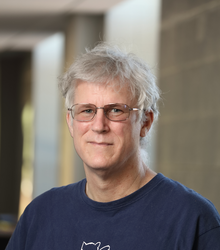
Peter Arnold
Ph.D., 1986, Stanford
Professor
Theoretical Nuclear and Particle Physics,Theoretical High Energy Physics
Research Interests
Prof. Arnold studies the theory of the strong, weak, and electromagnetic interactions at extremely high, relativistic temperatures, such as in the very early Universe (less than a millionth of a second after the Big Bang) or in relativistic collisions in heavy ion accelerators. Topics he has studied include investigating why there is significantly more matter than anti-matter in the Universe and understanding the properties of quark-gluon plasmas. The theoretical methods used for these very high energy problems (as much as a quadrillion degrees Kelvin) can also be applied to certain problems at very low temperatures (less than a millionth of a degree above absolute zero), and Prof. Arnold has also made some detours from his usual work on particle theory to study the transition temperature for Bose-Einstein condensation of dilute gases of extremely cold atoms.
For lay descriptions of some of Prof. Arnold’s research, click here (quark-gluon plasmas) and here (older work on the problem of matter/anti-matter asymmetry). For Prof. Arnold’s HEP-related publications, click here.
Selected Publications
P. Arnold, S. Iqbal, and T. Rase, "Strong- vs. weak-coupling pictures of jet quenching: a dry run using QED," [arXiv.org:1810.06578]
P. Arnold and S. Iqbal, "The LPM effect in sequential bremsstrahlung," JHEP 04 (2015) 070 [arXiv.org:1501.04964]
P. Arnold, P. Szepietwoski, D. Vaman, and G. Wong, "Tidal stretching of gravitons into classical strings: application to jet quenching with AdS/CFT,” JHEP 02 (2013) 130 [arXiv.org: 1212.3321]
P. Arnold, C. Dogan, and G. Moore, “The bulk viscosity of high-temperature QCD,” Phys. Rev. D74 (2006) 085021 [arXiv.org: hep-ph/0608012]
P. Arnold and G. Moore, "Transition temperature of a dilute homogeneous imperfect Bose gas," Phys. Rev. Lett. 87 (2001) 120401 [arXiv.org: cond-mat/0103228]
P. Arnold and L. McLerran, "Sphalerons, small fluctuations and baryon number violation in electroweak theory," Phys. Rev. D36 (1987) 581.
News Items
Honors
For accomplishments in developing gauge theories at high temperature.
Departmental Committees
APS, AAAS Fellowship & Other External Recognitions Committee (Member)
Chair's Advisory Committee (Chair)
Graduate Program Committee (Member)